In this article
Fashion and D2C apparel brands produce 10x more product imagery without new shoots by converting single high-resolution flatlays or packshots into photorealistic on-model lookbooks using locked AI character references and pose conditioning. Decoupling garments from studio logistics enables brands to produce 400+ catalog assets in 24 hours while cutting costs by 85%.
Editorial review: Berrys Team · 3 November 2026. Practical methodology and economic benchmarks tested across commercial apparel lookbooks and regional Southeast Asian e-commerce catalogs.
Why is traditional apparel photography the ultimate growth bottleneck for D2C brands?
Traditional fashion shoots create severe growth bottlenecks because producing 40 seasonal garment lookbooks requires casting 2 to 3 models at $400–$1,200 per day (approx. SGD 500–1,500), hair and makeup at $250–$500 (approx. SGD 300–600), and studio rentals at $600–$1,500 (approx. SGD 800–2,000). Combined with a 2 to 4 week retouching delay, a single 40-garment drop consumes $4,500–$9,000+ (approx. SGD 6,000–12,000+) before a single ad runs.
Omnichannel commerce demands far more than one clean catalog photo. Converting shoppers requires 8 to 10 visual assets per SKU:
- E-Commerce PDP Slots: Front standing, 45-degree angle turn, back closure details, and macro fabric close-ups.
- Marketplace Listings: High-contrast square crops meeting strict indexing rules on Shopee and TikTok Shop.
- Paid Ad Creatives: High-converting 9:16 vertical video overlays and aspirational lifestyle scenes for Meta and TikTok ad sets.
Producing 320 to 400 finished assets for a 40-garment drop demands three full studio days. If samples arrive late or wrinkle, brands face compromised standards or $1,900 emergency reshoots (approx. SGD 2,500), causing teams to ration creative until ad fatigue inflates acquisition costs.
How do high-growth fashion brands produce 10x more product imagery without new shoots?
High-growth fashion brands produce 10x more imagery by decoupling physical garment capture from model photography: capturing one high-resolution flatlay or ghost mannequin packshot, then generating infinite on-model variations using locked AI identity anchors and pose wireframes. This composable pipeline generates 400+ on-model, multi-angle catalog and lifestyle assets in under 24 hours at $2–$4 per finished image (approx. SGD 2–5).
This shift transforms photography from a logistics bottleneck into a modular software pipeline:
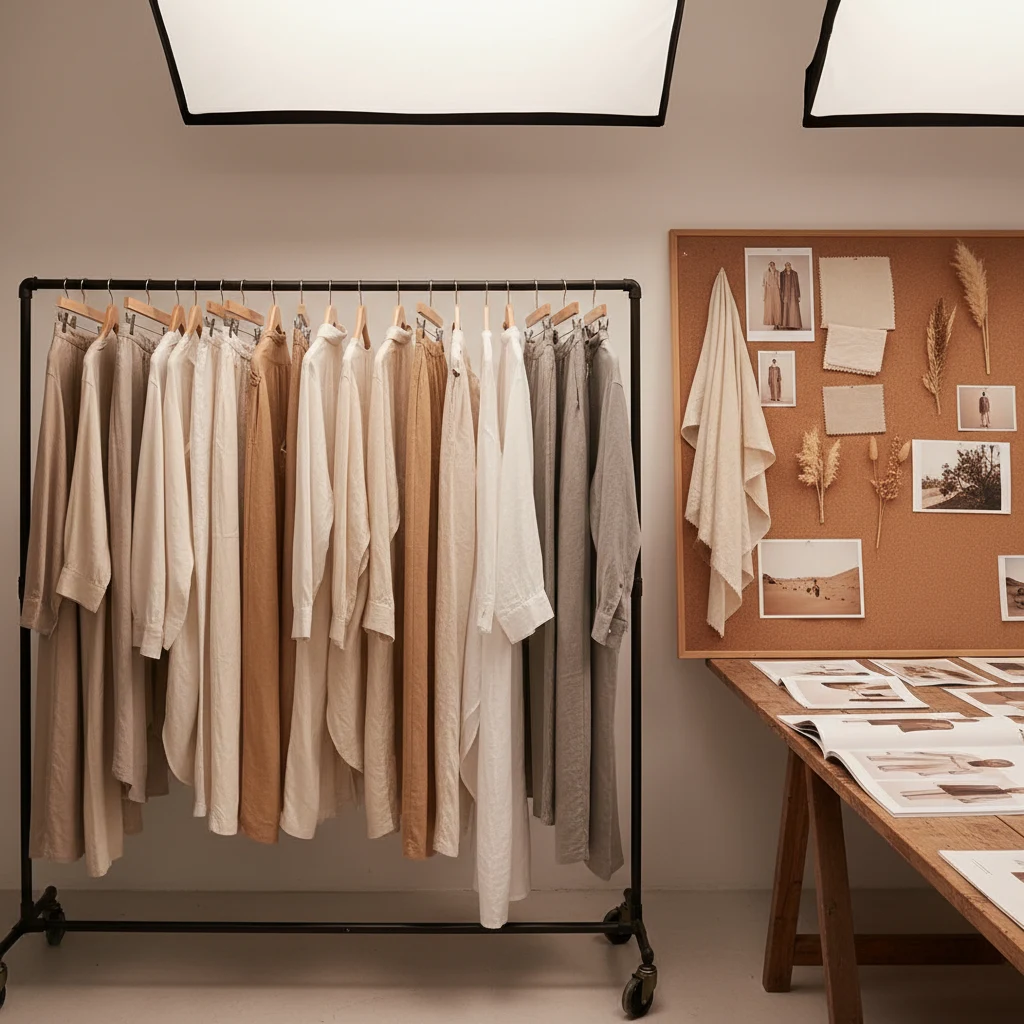
- The Physical Garment Master: Brands capture samples once via tabletop flatlays under neutral 5500K softbox lighting, preserving ground truth: dye shades, button spacing, and textile weave.
- The Brand Virtual Talent Roster: Instead of paying recurring agency rates, brands anchor virtual talent profiles. Identity embeddings ensure models maintain identical facial structure across thousands of sequential renders.
- Pose Rigging & Conditioning: Using skeletal pose rigging (such as OpenPose wireframes and depth maps), creative directors select exact stances. The pipeline maps garments onto virtual talent, delivering 10 to 25 catalog assets in minutes.
How do the unit economics compare: Traditional shoot vs ghost mannequin vs AI virtual workflow?
Across a 40-SKU seasonal collection requiring 240 finished assets, traditional shoots cost $6,000–$10,500 (approx. SGD 8,000–14,000) with 3-week turnaround, ghost mannequins cost $2,700–$4,500 (approx. SGD 3,600–6,000) with zero model lifestyle appeal, while AI virtual workflows cost $450–$900 (approx. SGD 600–1,200) with 24-hour turnaround. Virtual workflows cut unit cost per asset from about $35 (approx. SGD 45) down to $2–$4 while multiplying creative asset volume tenfold.
Comparing operational economics across 40 seasonal garment SKUs requiring 240 delivered assets:
| Production Parameter | Traditional On-Model Shoot (40 SKUs) | Ghost Mannequin Studio (40 SKUs) | Berrys AI Virtual Workflow (40 SKUs) |
|---|---|---|---|
| Talent & Crew Fees | $2,250–$4,100 (2 models, MUA, stylist; approx. SGD 3,000–5,500) | $0 (Photographer only) | $0 (Proprietary locked virtual talent) |
| Studio & Lighting Rental | $1,800–$3,400 (3 production days; approx. SGD 2,400–4,500) | $900–$1,500 (1.5 packshot days; approx. SGD 1,200–2,000) | $0 (In-house tabletop flatlays) |
| Post-Production & Retouching | $1,800–$3,000 ($8–$11/image retouch) | $1,050–$1,650 (Clipping & hollow neck) | Included in automated generation pipeline |
| Total Production Cost | $5,850–$10,500 | $1,950–$3,150 | $450–$900 |
| Turnaround Time | 18 to 28 business days | 7 to 10 business days | Under 24 hours |
| Total Assets Delivered | 120–240 images | 80–120 images | 400–1,000+ images |
| Blended Cost Per Asset | $35.00–$50.00 | $21.00–$26.00 | $2.50–$4.00 |
| Lifestyle Appeal | High (expensive location permits) | Zero (cold silhouette only) | Infinite promptable lifestyle settings |
| Reshoot Friction | Full day studio rebooking required | Repositioning & re-clipping required | Instant digital re-render (<2 minutes) |
Beyond direct financial savings, the primary advantage is launch velocity. In fast fashion, four-week studio delays miss peak trend search volume. Virtual pipelines allow brands to shoot flatlays at noon and launch fully populated PDPs before midnight. Furthermore, on-model imagery outperforms ghost mannequins by 22% to 38% in conversion rate because shoppers evaluate fit through human proportion.
What are the technical mechanics of preserving fabric drape, knit texture, and pattern alignment?
Preserving fabric fidelity in AI apparel imagery requires image-conditioned masked in-painting rather than text-prompted diffusion. By isolating the garment layer, extracting high-frequency normal maps for knit and weave textures, and locking button spacing and seam tensions against a pose wireframe, virtual engines render physically accurate fabric drape without smearing prints or distorting textile weight.
Consumer AI tools fail in apparel due to fabric hallucination. If software alters buttons, weaves, or checks, returns surge beyond the typical 20% to 30% e-commerce baseline where visual discrepancy drives customer churn.
Professional virtual pipelines prevent fabric drift through four technical layers:
- High-Frequency Texture Extraction: Isolates the source photo's frequency layer. Microscopic details—such as corduroy wales, linen slub, and twin-needle stitching—are preserved in a texture buffer and re-projected onto the synthesized surface.
- Depth-Conditioned Tension Folding: Fabric drapes according to gravitational physics and textile stiffness. A 400 GSM hoodie drapes with stiff folds, whereas a 90 GSM silk blouse creates fluid ripples. Depth conditioning calculates realistic tension creases around armpits and hemlines.
- Seam Tension & Pattern Vectors: For patterned apparel—including tartans, pinstripes, and houndstooth—pipelines lock pattern vector grids. Motifs scale proportionately across sizes, maintaining geometric seam alignment.
- Hardware Masking: Zippers, engraved metallic buttons, drawstrings, and collar stays cannot tolerate generative variation. The pipeline segments these micro-elements into protected bounding boxes, transferring them directly from the studio master with 100% optical fidelity.
How do you scale multi-channel imagery for TikTok Shop and Shopee compliance?
Fashion brands scale multi-channel imagery by configuring batch exports against strict platform listing specifications: TikTok Shop mandates 600x600px minimum front-facing solid covers where products occupy 60% or more of frame, while Shopee requires 1:1 square aspect ratios under 2MB. Automated rendering generates dedicated marketplace covers and lifestyle carousels from the same parent master.
Scaling brands frequently produce lookbooks that violate strict marketplace compliance algorithms:
- TikTok Shop Compliance: Primary covers must feature a clean, solid background with garments front-facing and occupying at least 60% of total frame area (minimum 600x600px, 1200x1200px recommended). Platform policies penalize synthetic renders deviating from physical items shipped.
- Shopee & Shopee Mall Specifications: Requires mandatory 1:1 square aspect ratios across all slots (minimum 500x500px, 1024x1024px recommended) under 2MB in JPG/PNG format. Shopee Mall prioritizes solid neutral backdrops for cover slot 1.
- D2C Storefronts & Social Ads: Shopify storefronts perform best with 3:4 portrait (1500x2000px) framing. Paid social ads require full-bleed 9:16 vertical safe zones (central 1080x1350 free of UI obstructions) produced via automated out-painting.
The virtual pipeline generates a white 1:1 square cover for Shopee and TikTok Shop, multi-angle PDP shots, and 9:16 vertical compositions for paid social campaigns simultaneously.
What is the step-by-step pipeline to transform 1 flatlay packshot into 10 on-model catalog assets?
Transforming a single flatlay packshot into ten on-model catalog assets follows a four-step pipeline: capture a high-contrast physical packshot, isolate the garment alpha mask, apply your brand's locked virtual model reference, and render ten curated pose wireframes across catalog and lifestyle scenes. The entire automated workflow completes in 20 minutes per garment SKU.
Here is the exact production workflow utilized by high-volume apparel brands inside Berrys Canvas:
- Capture Clean Garment Master: Lay the steamed garment flat under two diffuse 5500K softbox lights. Snap a high-resolution RAW photo ensuring buttons are fastened and collars are symmetrical.
- Automated Segmentation & Masking: Upload packshots to generate an alpha mask tagging boundary zones across neckline, cuffs, waistline, and hemline.
- Bind to Locked Brand Talent: Match garment dimensions to your virtual model profile, keeping facial structure and skin undertones locked to brand standards.
- Batch Render 10-Pose Matrix: Render ten curated presets spanning PDP Frontal (neutral studio), Three-Quarter Turn, Rear View, Walking Stride, Seated Lifestyle, Hands-in-Pockets, Torso Close-Up, Urban Sidewalk, Cafe Editorial, and Vertical 9:16 Social Safe-Zone.
Before publishing, conduct a rapid 60-second visual audit verifying hand anatomy, collar clearance, seam alignment, contact shadows, and color accuracy.
Frequently Asked Questions
Can AI virtual models replace all physical fashion photography?
AI virtual models replace 80% to 90% of routine catalog, PDP, marketplace, and performance ad photography where volume and speed dominate. Physical shoots remain essential for hero campaigns requiring celebrity talent, extreme sports motion, or tactile physical interaction. Modern D2C brands run flagship campaigns with physical talent and power catalog volume, colorways, and multi-channel ad variants through automated virtual pipelines.
Will marketplace algorithms on TikTok Shop or Shopee penalize AI on-model imagery?
Marketplaces do not penalize AI on-model imagery provided listings adhere to technical standards and accurately represent the physical product. TikTok Shop and Shopee prioritize image clarity, high resolution, standard aspect ratios, and solid primary backgrounds. Penalties occur only when synthetic garments deviate from physical items shipped. Workflows anchored to real physical packshots maintain 100% garment truth.
How do brands prevent customer returns when using AI-generated apparel imagery?
Brands prevent returns by strictly enforcing fabric fidelity protocols. Return spikes occur when software alters fabric weight, button counts, seam stitching, or dye shades. In image-conditioned workflows, the physical garment master is masked and projected onto virtual models, preserving exact textile weave, button spacing, and color values, backed by flatlay packshots in PDP carousels.
How does an apparel brand maintain model diversity across global sales channels?
Virtual model pipelines allow brands to maintain inclusive, globally diverse talent rosters without incurring astronomical casting and travel expenses. Brands create modular virtual rosters featuring diverse ethnicities, skin tones, and body proportions. When launching internationally, the exact same garment packshot renders on Southeast Asian talent for Shopee, Caucasian talent for Europe, and modesty-styled talent for Gulf storefronts.
Put the ideas to work.
Brief our studio. Get back finished, on-brand creative.
Talk to us ↗