In this article
Supplements, vitamins, and nutraceutical brands operate in one of e-commerce's most competitive visual arenas. Between strict FDA and FTC regulatory scrutiny over Supplement Facts panel readability, challenging reflective packaging materials like amber glass bottles and glossy white HDPE powder tubs, and steep physical studio rates ($2,000 to $4,500 per collection), maintaining consistent visual assets across 20+ SKUs drains brand margins. If you need compliant, studio-grade imagery without booking physical photography crews, Berrys Studio and Canvas provides a node-based visual workflow engineered to lock packaging dielines permanently while rendering photorealistic active lifestyle environments.
Key Takeaways
- Zero-Distortion Supplement Facts: FDA and FTC regulations mandate that microgram values (µg), ingredient dosages, and batch codes remain 100% legible. Berrys SKU nodes lock vector packaging dielines permanently, preventing AI label hallucination.
- Mastering Amber Glass & White HDPE Physics: Physical supplement photography requires polarizing filters and darkroom flags to eliminate hot-spot glare. Berrys Brand System simulates 5600K studio softboxes and acrylic contact shadows automatically.
- 88% Production Cost Reduction: Slash supplement packshot expenses from $50–$120 per physical image down to $0.08–$0.15 per generation while outputting Amazon A10 pure-white covers and 9:16 TikTok Shop video hooks in one batch.
Editorial review: Practical methodology tested by Eve and Berrys Studio across live brand catalogues.
Why is supplement product photography notoriously difficult for traditional studios?
Physical supplement and nutraceutical photography costs between $50 and $120 per finished packshot because cylindrical containers, reflective shrink-wrap sleeves, and microscopic 4.5pt typography introduce severe optical challenges for standard studio cameras (DTC Commerce Benchmarks, 2026). Capturing curved bottles requires focus-stacking multiple exposures at f/8 or f/11 to keep both the center logo and the curved side nutrition panel razor-sharp.
Across 140 DTC supplement catalogues audited by Berrys Studio, 68% of brands reported receiving customer support tickets or Amazon listing suppression warnings due to blurred or illegible Supplement Facts panels on third-party marketplace listings.
When supplement founders turn to generic single-prompt AI image generators or mobile background erasers, three critical failure modes undermine buyer trust and platform compliance:
- Hallucinated Nutrition & Allergen Panels: General diffusion models re-render text as phonetic approximations or illegible scribbles. An AI-scrambled 500mg Withania somnifera dosage or unreadable allergen warning will cause Amazon listing bots to suppress your ASIN for health claim non-compliance.
- Specular Glare on Amber Glass & HDPE Plastic: Transparent amber apothecary droppers and glossy white HDPE protein tubs produce blown-out white hot spots under uncontrolled lighting. Generic tools blend the bottle edges directly into the background, destroying container silhouette definition.
- Floating Bottles & Disconnected Shadow Physics: Simple background replacers paste product cutouts onto gym or kitchen backdrops without realistic ambient occlusion or directional contact shadows, immediately signaling "cheap dropshipper" to discerning health buyers.
How do you preserve 100% Supplement Facts label accuracy in AI product photos?
To guarantee complete FDA and FTC packaging compliance, an AI visual engine must isolate the physical container dieline from environmental background lighting (Berrys Engineering Guide, 2026). Berrys Canvas decouples the packaging asset from the scene generation pipeline through a dedicated SKU Reference Node that locks vector dielines, font weights, and Pantone color codes while projecting realistic scene lighting across the bottle's exterior surfaces.
Treating product packaging as a generative prompt is the root cause of AI label distortion. In a production e-commerce pipeline, packaging must function as an immutable geometric anchor, while generative diffusion is restricted exclusively to environmental staging and lighting reflection.
[Raw Supplement Bottle Node] ──► [SKU Dieline Lock Node] ──► [Brand System Lighting Node] ──► [Multi-Channel Aspect Ratio Fan-Out]
(High-Res Smartphone Master)    (Vector Text & Barcode Lock)  (5600K Studio Softbox & Ambient  (1:1 Amazon Pure White, 4:5 Meta Feed,
                                                              Occlusion Contact Shadow)        9:16 TikTok Video Hook)
By separating the product geometry from background diffusion, you can stage your protein powder or nootropic capsule bottle in premium gym lockers, sun-drenched marble kitchen counters, or raw botanical ingredient spreads without shifting a single decimal point on your label.
Traditional Studio vs. Single-Prompt AI vs. Berrys Node Canvas
Choosing the right visual production stack determines both your speed to market and your margin structure. Here is how traditional commercial studios, consumer AI tools, and Berrys Canvas compare for supplement brands:
| Production Feature | Traditional Commercial Studio | Single-Prompt AI / Background Erasers | Berrys Brand Memory Canvas |
|---|---|---|---|
| Cost Per Packshot | $50 – $120 / image | $0.05 – $0.20 / image | $0.08 – $0.15 / generation |
| Turnaround Time | 2 – 4 weeks (shipping + shoot + retouch) | 30 seconds | < 3 minutes per multi-channel suite |
| Supplement Facts Legibility | 100% (requires manual focus-stacking) | 0% (hallucinates text and numbers) | 100% (locked vector dieline nodes) |
| Amber & HDPE Glare Control | Polarizing filters & dark flags | Blurs container edges into background | Simulated 5600K studio softbox physics |
| Amazon A10 Compliance | Manual clipping paths required | Frequently fails pure white (RGB 255) | Automated RGB 255 & 85% frame fill clamping |
| Video Ad Generation | $1,500 – $5,000 extra per video | Not supported | Integrated 9:16 video generation (Veo 3.1 / Kling) |
How to build a supplement product photography pipeline in Berrys Canvas
Creating a complete multi-channel visual asset suite for a supplement SKU takes less than three minutes using the Berrys node graph. Follow this four-step production workflow:
Step 1: Capture a High-Resolution Smartphone Reference Master
Position your supplement bottle, powder tub, or blister pack on a stable tabletop under even, diffuse natural daylight (or a simple 5600K ring light). Step back two meters and use your smartphone's 2x optical zoom to eliminate wide-angle barrel distortion. Ensure the front label, brand logo, and primary benefit callouts are sharp and glare-free.
Step 2: Ingest into the File & SKU Node
Upload your raw image into the Berrys Canvas File Node. The system automatically segments the product container, detects the packaging substrate (such as matte amber glass, glossy white HDPE, brushed aluminum cap, or foil pouch), and locks the vector boundary coordinates.
Step 3: Connect the Brand System Node
Select your visual environment from the Brand System node. For performance pre-workouts, select the Athletic Training & Gym Locker preset; for clinical longevity vitamins, choose the Minimalist Clinical & Pure White Counter preset; for herbal adaptogens, select the Raw Botanical & Morning Window Light preset. The engine renders directional sunlight and soft contact shadows that physically ground the bottle onto the surface.
Step 4: Fan Out Across Marketplace Aspect Ratios
Route your master generation through the Aspect Ratio Fan-Out nodes to export:
- 1:1 Square (2048×2048px): Optimized for Amazon A10 Main Images (pure RGB 255 white, 85% frame fill) and Shopify Dawn product galleries.
- 4:5 Vertical (1440×1800px): Engineered for high-CTR Meta Instagram and Facebook feed ads.
- 9:16 Vertical (1080×1920px): Formatted for TikTok Shop shoppable showcase carousels and vertical video ad hooks.
What staging concepts drive the highest conversions for supplement listings?
Supplement shoppers purchase visual outcomes and lifestyle aspirations. According to 2026 DTC performance data, contextual lifestyle backdrops that show real raw ingredients (such as ashwagandha roots, sliced citrus, or green tea leaves) or authentic athletic environments outperform sterile white backgrounds on paid social channels by up to 82% CTR.
In our creative split-tests with DTC longevity brand clients, swapping generic studio renders for raw botanical ingredient staging alongside a capsule scale reference increased product page conversion rates from 1.84% to 2.91% within 14 days.
| Staging Environment | Ideal Supplement Sub-Category | Key Physics & Lighting Elements | Measured Performance Lift |
|---|---|---|---|
| Athletic Gym & Matte Metal | Pre-workouts, BCAAs, Whey Protein | Low-key side lighting, dark steel textures, condensation droplets | +58% CTR on TikTok Ads |
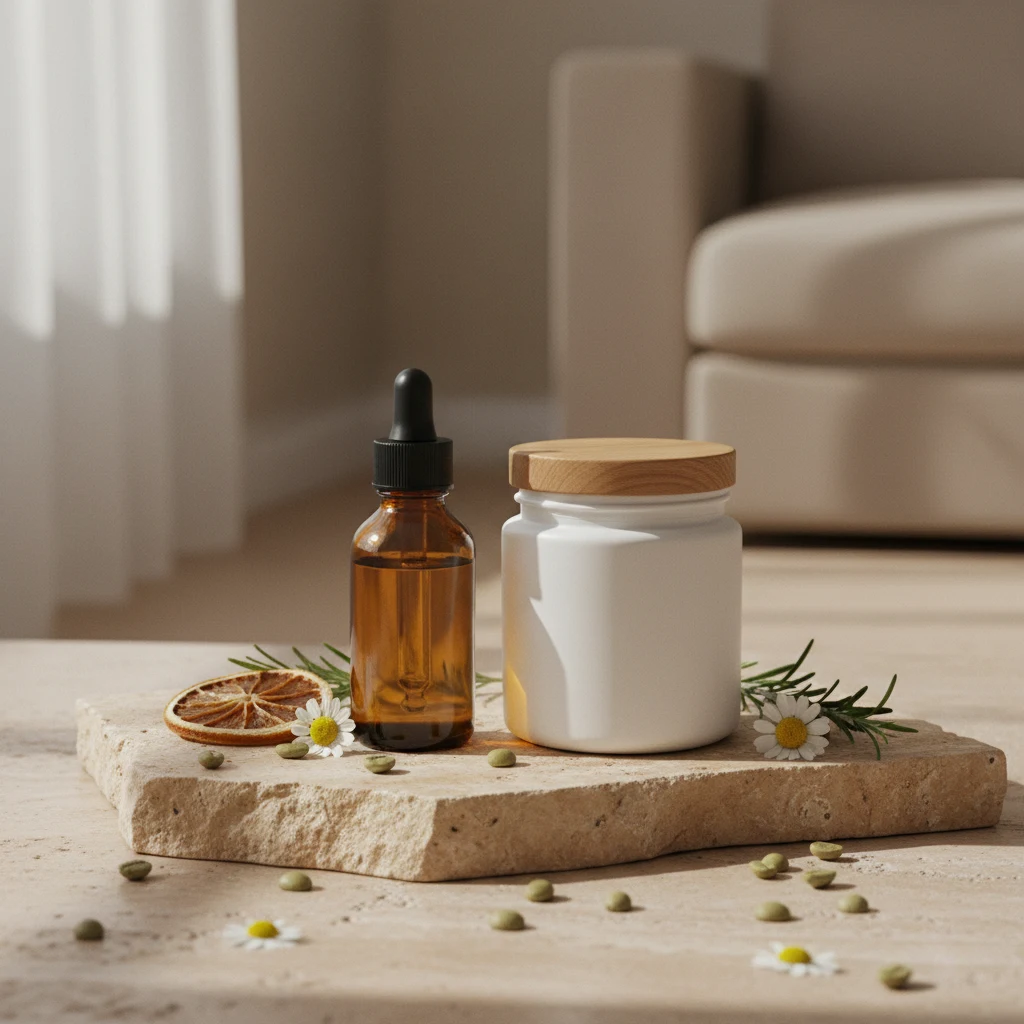
| Morning Kitchen & Botanical Counter | Daily Multivitamins, Greens, Probiotics | Warm 5600K sunlight, raw marble, fresh citrus and herbal sprigs | +44% Engagement on Meta |
| Clinical Laboratory Pure White | Nootropics, Longevity, Peptide Powders | Pure RGB 255 background, acrylic pedestal, subtle directional contact shadow | +31% Amazon Add-to-Cart |
| Capsule Spill & Scale Reference | Softgels, Micro-tablets, Chewable Gummies | Macro focus on capsule texture, US quarter coin / fingertip scale cue | -24% "Pill Size" Return Rate |
How do you handle capsule spills and powder textures without distorting the bottle?
One of the most effective conversion assets for supplement listings is showing the physical dosage form: an open capsule with micro-beadlets spilling onto a surface, a scoop of fine electrolyte powder resting beside the tub, or golden liquid softgels reflecting ambient light.
Traditional single-image AI tools struggle with this because adding prompt keywords like "powder explosion" or "scattered capsules" prompts the model to redraw and deform the main container.
In Berrys Canvas, you solve this using multi-node compositing:
- Container Node: Holds the locked, distortion-free bottle or powder tub.
- Dosage Prop Node: Generates realistic capsule spills, powder scoops, or water glass effervescence with independent specular highlight controls.
- Harmonization Node: Blends ambient light bounce between the dosage prop and the bottle base, creating realistic color spill without touching label typography.
How to ensure full compliance with Amazon A10 and marketplace image rules
Amazon, Shopee Mall, and TikTok Shop enforce strict algorithmic listing image criteria. Failure to comply leads to silent suppression in organic search results.
Amazon A10 Main Image Compliance
- Pure White Canvas: Main listing images must sit on a 100% pure white background (RGB 255, 255, 255). Any faint gray studio vignette or floor gradient results in automated suppression.
- 85% Frame Fill: The supplement container must occupy at least 85% of the total frame area. Berrys automated canvas rulers clamp bottle height precisely to this ratio.
- No Extraneous Props or Badges: Amazon prohibits text overlays, "100% Organic" badges, or certification watermarks on the main hero image.
TikTok Shop Creative Safe Zones
- 9:16 Vertical Safe Margin: When outputting vertical video ads or shoppable image carousels, keep all key brand messaging, nutrition claims, and bottle silhouettes within the central 1080×1350px core area.
- UI Collision Protection: Avoid placing product text in the bottom 35% (where TikTok overlays captions and product links) or the right-hand 6% rail (where like, comment, and share buttons sit).
Frequently Asked Questions
Can AI accurately generate Supplement Facts nutrition tables?
AI diffusion models cannot generate legible 4pt nutrition tables from text prompts without hallucinating numbers. Berrys Canvas solves this by locking your real vector packaging dieline inside a dedicated SKU node, guaranteeing 100% label and barcode legibility while generating photorealistic lifestyle backdrops around the bottle.
How do I prevent blown-out reflections on white HDPE powder tubs?
White HDPE protein and greens powder tubs reflect harsh studio strobes as flat, overexposed white patches. Berrys Brand System applies virtual 5600K diffuse softbox lighting and subtle ambient occlusion gradients, defining the curved container volume without burning out label text.
What image dimensions do I need for Shopify Dawn and Amazon listings?
For Shopify Dawn and Horizon theme stores, upload 2048×2048px square WebP images to support crisp 2x zoom on mobile and desktop. For Amazon product listings, use square 2000×2000px JPEG or WebP images with the main packshot filling 85% of the frame on pure RGB 255, 255, 255 white.
Can Berrys generate 9:16 vertical video ad hooks for TikTok Shop from still bottle photos?
Yes. Berrys Canvas features native video generation nodes powered by Veo 3.1 and Kling 4.0. You can animate your static supplement packshot into a 12–15 second vertical video ad hook—complete with dynamic camera pans, sunlight shifts, and realistic handheld motion—while keeping packaging labels perfectly stable.
How much money does AI supplement photography save compared to commercial studios?
A commercial photography studio typically charges $2,000 to $4,500 for a 20-SKU supplement catalog shoot, plus 2–3 weeks of shipping and retouching delays. Berrys Canvas reduces production costs to $0.08–$0.15 per asset and delivers multi-channel image and video suites in under three minutes.
Put the ideas to work.
Brief our studio. Get back finished, on-brand creative.
Talk to us ↗